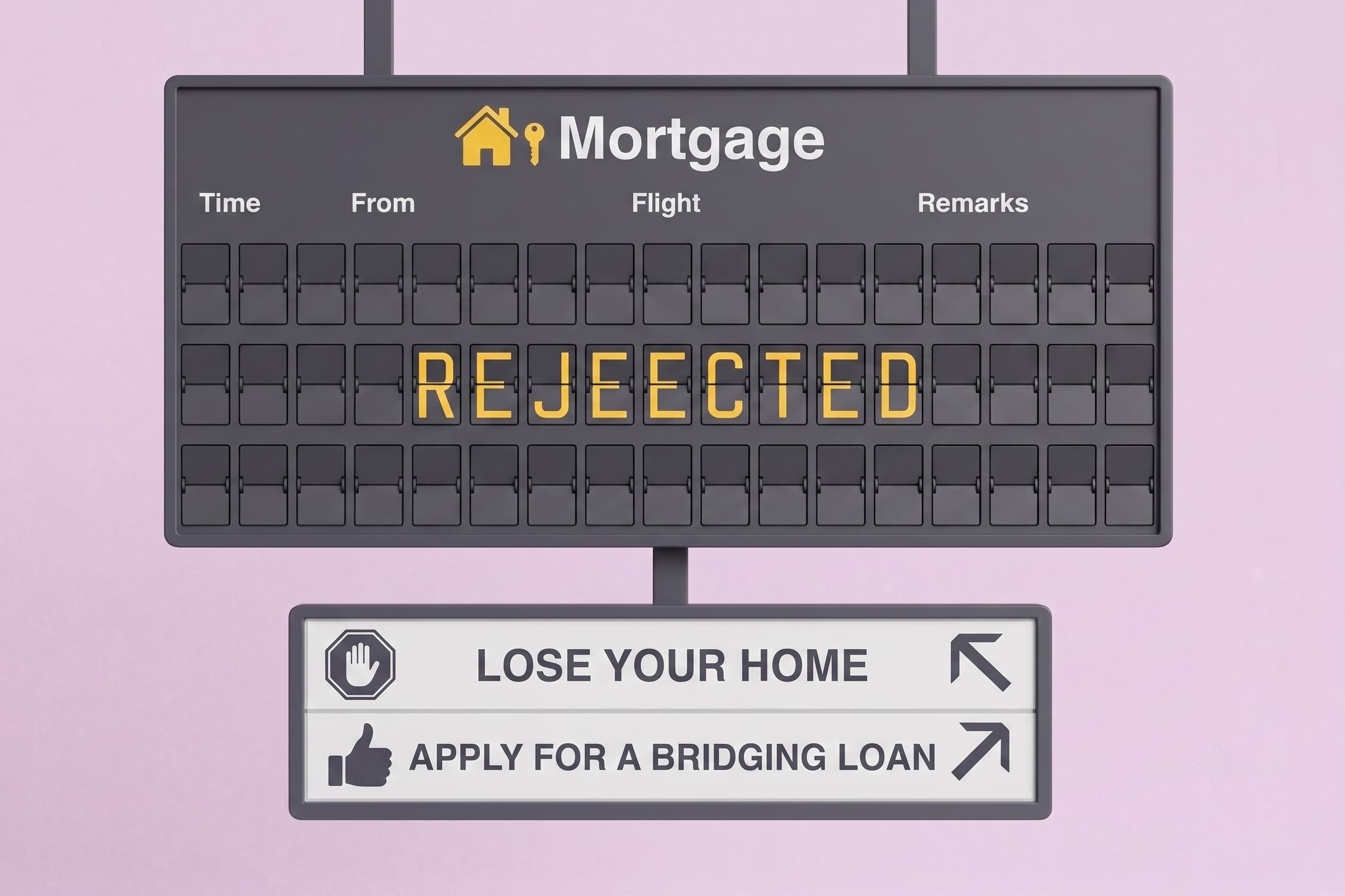

Your UK mortgage has been in underwriting for 8 weeks. The developer has set a completion date, but you are worried the funds might not arrive in time.
If you are buying UK property from abroad, this happens a lot. UK lenders usually take longer to check foreign income, overseas tax records, and bank statements. But developers almost never allow extra time for this in their deadlines.
This is when a bridging loan can help.
Bridging loans can be essential for your property investment. In fact, UK bridging loans reached a record £13.7 billion in 2025, according to BDLA, showing how popular they have become.
At GoGoProp, bridging loans are our expertise, and we cover foreign nationals and expats. In this concise guide, we will explain how bridging loans work, what they cost, who qualifies, and how to apply.
What is a bridging loan, and how does it work?
A bridging loan is short-term funding secured against property. It helps cover the gap until your longer-term financing is ready.
It differs from a mortgage in 4 ways:
- Bridging loans are short-term. They usually last around 1-12 months. You are not expected to keep this type of finance for years, and the pricing reflects that.
- The loan is secured against the property, not you personally. The lender has a legal claim on the property and can sell it to recover the debt if you do not repay.
- You usually do not make monthly payments. Interest is normally added up and paid at the end. Some lenders may take the first few months of interest upfront instead.
- It is repaid in one go, from a planned source. That source is your exit strategy, and it is the single thing lenders care about most, usually a buy-to-let mortgage or a sale.
In short, a bridging loan gives you extra time to secure a property you have had your eye on. You can complete the purchase now and arrange long-term finance later.
Since you are paying for speed, it is important to leverage it where it really helps.
What is a bridging loan used for?
Bridging loans are useful when you cannot move a deadline. For overseas buy-to-let investors, that situation looks the same every time:
- The property is right
- Time is short
- The mortgage is the bottleneck
There are 4 common cases where this happens:
1. New-build completion
When buying a new build, the developer sets a fixed completion date while your mortgage is still being processed. In this case, a bridging loan lets you complete the purchase on time, and your mortgage pays off the bridge loan once it is ready.
2. Auction purchases
Win at a UK property auction and you have 28 days to complete, far faster than any mortgage can be arranged. Auction finance is the bridging loan built for that deadline, and it is often the only way to meet it.
3. Unmortgageable or off-the-market property
Some flats and conversions cannot be mortgaged in their current state. Bridging finance covers the purchase and the work needed to fix that. You refinance onto a buy-to-let mortgage once the property is ready to let.
4. Refurbishment or portfolio additions
Where the works are the main event, refurbishment finance covers the purchase and the build budget in one facility. You buy the property, improve its rental value, then refinance or sell once the work is finished.
What types of bridging loan are there?
Bridging loans in the UK are commonly grouped into types based on 2 key factors: regulatory status and security priority.
This means a bridging loan may be regulated or unregulated, and it may also be structured as either a first-charge or second-charge loan.
1. First-charge and second-charge
The charge is the lender's legal claim on your property. Its order decides who gets paid first.
If nothing else is secured on the property, your bridging lender takes a first charge. If there is already a mortgage, the bridging loan sits behind as a second charge, and the mortgage lender is repaid first.
A second charge costs more and requires written consent from the first lender, which can slow things down. Most lenders for overseas buyers will only lend on a first charge.
2. Regulated and unregulated
The use of the property decides this, not your preference. A regulated bridging loan is secured against a property you or close family will live in, so it falls under Financial Conduct Authority mortgage rules.
If you are buying to let, your loan will be unregulated because you are renting out the property instead of living in it. Most lenders, including GoGoProp, only offer unregulated loans.
Can a non-UK resident get a bridging loan?
Yes, non-UK residents can get a bridging loan, although the process is more limited than for UK residents.
High-street banks do not offer bridging loans, so you will need to work with specialist lenders. Only some of these accept applicants living outside the UK.
Where you live and your nationality matter more than your wealth. Lenders make decisions based on anti-money laundering (AML) risk, sanctions screening, and the practicality of completing KYC (Know Your Customer) checks remotely.
For example, buyers from FATF-compliant countries like the UAE, Singapore, Hong Kong, Australia, and the US usually have the most options. If you are from a higher-risk country, expect more checks and fewer lenders, no matter your finances.
Because bridging loans are secured against the property, you do not need a UK bank account or UK credit file, but you do need clean, well-documented funds. Certified ID, proof of address, and clear evidence of the source of your funds are standard requirements. The most common reason for an application stalling is unexplained funds that have moved through several countries.
The main trade-off is the amount you can borrow: UK residents often reach 75%-80% loan-to-value, while non-residents are usually capped at 60%-70%. As a result, you should budget for a larger deposit than a UK-focused guide would suggest.
Notice what none of these limits are about: your income, your credit score, or the quality of the deal. They are about which lenders have built for overseas buyers and which have not. That is the one variable you control.
See bridging loans for foreign nationals and expats:
GoGoProp holds Money Lending Licence No. 1341/2025.
What are the advantages and disadvantages?
Here is a full breakdown of the pros and cons of bridging loans:
Bridging loans are highly recommended when you need to move quickly on a property deal, especially:
- You need to complete faster than a traditional mortgage allows;
- The property is not yet mortgageable; or
- Your long-term funding, e.g., a mortgage, is not yet available.
There is one risk worth planning for: when your bridging loan ends, you need a buy-to-let mortgage to repay it, and not all mortgage lenders accept non-residents. Make sure a specific lender will accept you before you take out the loan, not after.
What do lenders check before they approve you?
Lenders usually check for 3 main factors in a bridging loan application:
- Exit strategy: Your plan for repaying the loan, usually by selling the property or refinancing. Lenders care most about this and will test it first. Your exit plan is more important than your income or credit score.
- The property: Standard residential buy-to-let is the easiest to finance. Small studios, flats above commercial units, or unusual construction can limit your options and make refinancing harder later.
- Your jurisdiction: Where you live and your nationality decide whether a lender can consider your application at all, even before reviewing any other details.
These 3 factors decide if a lender will engage with your application. Everything else is supporting evidence, and the full list of checks runs to 7 requirements. Loan-to-value matters too, but you can plan for it, so it gets its own section next.
How much can you borrow?
As a non-resident, you can usually borrow 60%-70% of a property’s value. But there is a catch: the amount you receive may be less than you expect, and that is where many people get caught out.
Lenders talk about loan-to-value (LTV) in 2 ways: gross and net
- Gross LTV is the advertised loan amount before any fees or interest are deducted.
- Net LTV is what ends up in your solicitor’s account, the real number you can use for your purchase.
These deductions come out of the loan itself, not your pocket. So, if a lender advertises 75% gross LTV, you are not actually getting 75% of the property’s value. For example, on a £400,000 property:
*Deductions here assume a 2% arrangement fee and three months’ retained interest at 1% per month.
Tip: Always ask whether a quote is gross or net before comparing offers. On a £400,000 purchase, this difference can be £15,200, more than most people save by shopping for a better rate.
What does a bridging loan cost?
Bridging loans cost more than mortgages, and the interest rate is only one part of the total expense.
Lenders usually quote bridging loan rates monthly, typically between 0.5% and 1.5%, depending on the lender, the property, and your circumstances.
Here is a breakdown of the main costs you should expect:
Those ranges give you the shape of the cost. Our full cost breakdown works a single loan through end to end, down to how much reaches your solicitor.
There are 2 extra costs that often surprise overseas buyers:
- 2% Stamp Duty surcharge for non-UK residents: This is added to standard rates and any surcharge for additional properties. On a £400,000 property, that's an extra £8,000.
- Currency risk: Exchange rate changes affect you twice: when funding your deposit and when repaying the loan. A 5% move on a £300,000 loan can mean a £15,000 difference, about five months of interest.
Tip: Ask every lender for the total repayment figure in pounds for your expected term. That number is more useful than any rate comparison.
How long does a bridging loan take?
For most straightforward applications with all paperwork ready, expect the process from application to funds to take around 3 to 5 weeks.
Some specialist lenders are faster, but advertised timelines are best-case scenarios. Bridging loan timelines slip for a handful of predictable reasons, and the valuation is the most common.
How do you apply for a bridging loan?
Here is how the bridging loan process works for overseas buyers, starting from the beginning:
- Find a specialist lender: Not all lenders accept non-residents, so check that your nationality and country of residence are eligible before you go any further.
- Gather your documents: You'll need certified ID, proof of address, documentation of your source of wealth, and proof of funds. Non-English documents may need translation and notarisation.
- Submit your application: Provide the property address, purchase price, loan amount, and your exit strategy. The lender uses this information to give you a decision in principle.
- Complete the valuation and legal work: A RICS-qualified valuer will inspect the property, while your UK solicitor handles the legal side. Check signing requirements early, as many lenders require documents to be signed in front of a legal professional in your home country.
- Accept your offer and receive your funds: Once everything is complete, the lender sends a formal offer and transfers the funds to your solicitor’s account.
- Repay when you exit: Your solicitor then repays the loan from the proceeds of your sale or refinance, and the legal charge is released.
Choosing a bridging lender: What to look for?
Bridging for overseas buyers sits outside of high-street banks. That is why a specialist market now exists, with lenders who understand the unique needs of non-resident investors.
Here is what sets good specialist lenders apart:
- Decisions based on the property: Underwriters focus on the asset and your exit plan, rather than trying to fit foreign income into a rigid UK affordability model.
- Built for speed: With in-house underwriters and streamlined processes, these lenders can often give you an answer in days, which is usually what matters most.
- Flexible criteria: Unusual properties, income in multiple currencies, and no UK credit file are common here, not reasons for automatic rejection.
- Experience with international paperwork: They’re used to notarised documents, remote signing, and providing proof of funds across borders.
The differences between lenders can be significant, and you’ll notice them more in the total cost than in the headline rate. When comparing, ask if a lender has actually funded borrowers from your country before, not just if they technically can.
Also, get the full costs in writing, and check how they handle notarised documents and remote signing. It’s also smart to ask about extension fees before you ever need one.
If you want to dive deeper, our article about specialist lenders walks through the process with real examples, so you can see how the pieces fit together in practice.
GoGoProp: Funding overseas buy-to-let investors at speed
At GoGoProp, we offer bridging loans to overseas investors buying UK residential buy-to-let. That single focus is why the process fits the way you actually buy. We offer:
- Up to 75% net LTV, quoted net, so the figure you see is what reaches your solicitor
- Loans from £100,000-£750,000
- Terms from 3-12 months
- 1% per month flat and a 2% handling fee, disclosed upfront
- No early repayment penalty. Overpaid interest is refunded on your redemption statement
- Decision in 24 hours, funds in around 10 days
- The same terms for every nationality
If a completion date is closing in and your mortgage will not arrive in time, that is the deal we fund. We also release equity from UK property you already own. Both products, with full terms, are on our bridging loans page:
GoGoProp lends under Money Lending Licence No. 1341/2025.
Key takeaways
- A bridging loan is short-term finance secured against property, repaid in one go from a planned exit.
- Investment property means unregulated bridging, and most non-resident lending is first charge only.
- Your exit strategy matters more to a lender than your income or credit file.
- Plan on 60%-70% loan-to-value, and always ask whether a quote is gross or net. The difference is £15,200 on a £400,000 property.
- Non-UK residents pay a 2% Stamp Duty surcharge on top of standard rates.
- If your exit fails and no extension is agreed, the lender can force a sale.
Frequently asked questions
1. How is a bridging loan different from a standard mortgage?
A bridging loan is short-term, usually 1-18 months, with interest added up and paid at the end. A mortgage is long-term with monthly repayments. Bridging loans are quicker to arrange and more flexible, but much more expensive.
2. How is a bridging loan different from a personal loan?
A bridging loan is secured on the property, so the property is at risk if you do not repay. A personal loan is unsecured and assessed on your income, which rules out most non-residents.
3. Why can a bridging lender move so much faster than a bank?
Because it underwrites a different thing. A bank assesses your income over decades; a bridging lender assesses the property and how you will repay within months. Fewer checks, faster decision.
4. Do you need a UK solicitor to take a bridging loan?
Yes. Funds move through a UK solicitor's client account, and the lender instructs its own firm alongside yours. A slow solicitor is one of the most common causes of delay.
5. Do you make monthly payments on a bridging loan?
Usually not. Interest is normally rolled up and settled in one payment at the end, which is why the loan reduces what you can draw down. Some lenders let you service it monthly instead.