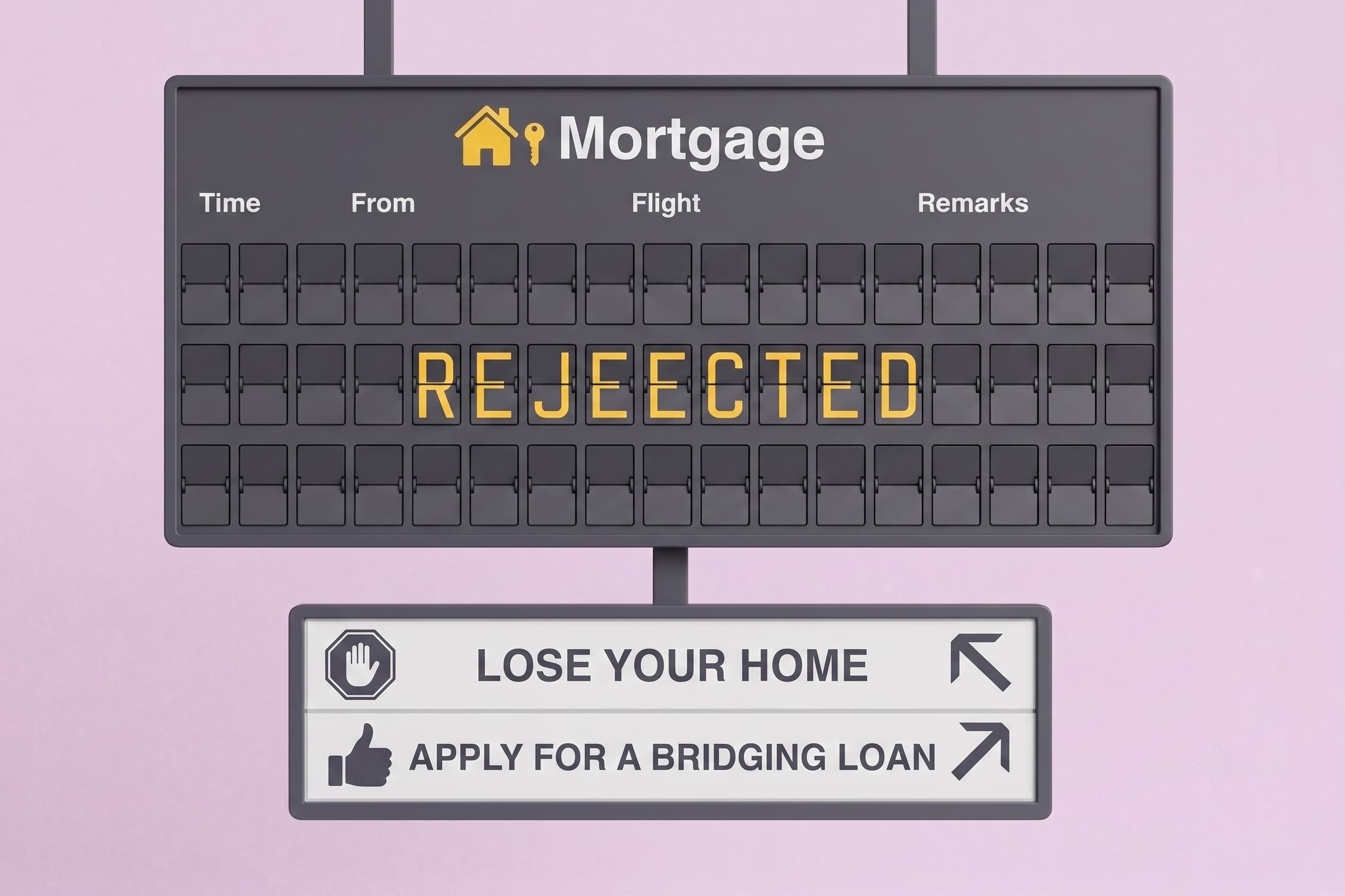

Was your UK mortgage application declined as a non-resident?
While getting refused a mortgage can be discouraging, you're not out of options.
In this guide, we'll walk you through the most common reasons lenders turn down non-resident applications, what you can do to fix them, and how to approach your next application with confidence.
We'll also cover alternative financing routes, including bridging loans and refinancing, for when you need to move fast and can't afford to wait.
What are some reasons for being refused a mortgage?
Lenders may decline your mortgage application if your finances do not meet their criteria. For non-residents, these requirements are usually even stricter.
Here are the most common reasons we've seen and helped clients work through:
- No UK credit history: Most UK lenders, especially high-street banks, check your UK credit history. Credit you’ve built in other countries won’t show up for them.
- Foreign income or self-employment: High-street banks rely on UK payslips and HMRC records. If you earn money from overseas contracts or are self-employed outside the UK, that income usually won’t count.
- Insufficient income: Lenders often deduct 10-25% from foreign income to cover exchange-rate risk. For example, a $100,000 salary might be counted as only £58,000 in their calculations.
- Too many credit applications: Non-residents often check with several specialist lenders, but making multiple applications within 30 to 90 days can make lenders think you’re having financial difficulties.
- Overseas debt: Lenders can’t see foreign credit reports, but overseas debts will show up on your bank statements. These debts will count against you.
- Unmortgageable property: Most lenders avoid properties with unusual construction, short leases, or those above commercial units, even if your finances are solid.
- Incomplete documentation: Lenders check your money sources more strictly if you’re a non-resident. Missing paperwork can cause your application to fail, even if everything else is fine.
Note: Sometimes, a rejection has nothing to do with your finances. Lenders may change their policies without warning, so your application might suddenly no longer meet their criteria.
What can I do if my mortgage application is declined?
If your mortgage application is refused, do not reapply just yet. Find out exactly why it was rejected, and fix it before approaching another lender.
Here is what you can do to avoid another rejection:
Step 1: Get the reason in writing
Lenders are not legally obliged to explain their reason for declining, but you should always ask.
Don’t settle for vague answers like "doesn't meet our criteria." Knowing whether it was a credit issue, an income problem, or a policy change will guide your next steps.
Step 2: Address the exact reason for your decline
Here are a few ways to improve your chances when reapplying, depending on why you were rejected:
Step 3: Go to a specialist lender
If a mainstream bank has turned you down, a specialist mortgage lender may be worth trying instead. These lenders can take into account foreign income, overseas credit history, and unusual financial circumstances.
Bear in mind that each specialist lender has its own rules, so what one will accept, another may not.
Step 4: Time your re-application
There is no required waiting period, but rushing usually doesn’t help. Sometimes, it is best to wait 6-12 months. While you wait, here are some ways to strengthen your next application:
- Build a UK credit footprint
- Wait for a stronger visa status, like an Indefinite Leave to Remain
- If you’re new to your job, allow six months of payslips to accumulate
But what if you've already exchanged contracts and the completion date is at risk?
What are some other ways to finance my home?
If a mortgage decline is putting your deal at risk, bridging loans and refinancing are two strong alternatives.
Option 1: Bridging loans
Bridging loans are ideal for anyone looking to purchase a new property, from first-time buyers taking their first step to seasoned investors moving quickly on opportunities. They are short-term, secured loans that let you complete a property deal in 2-3 weeks. The loan covers the purchase while you sort out your long-term mortgage, and you repay it once your mortgage is approved.
Bridging loans are usually more expensive than a standard mortgage. The rates are higher than those of a standard mortgage, at around 9-17% annually.
However, bridging loans are a different product built for a different purpose. They are about speed and flexibility, for time-sensitive situations such as:
- Properties nearing completion with a payment deadline too tight for a long-term buy-to-let mortgage
- Auction purchases
- Properties under renovation
Sometimes, the real cost is missing out on the right property altogether.
For example, a Ghanaian couple once came to us because their mortgage lender delayed their application due to their overseas residency. This put both their deposit and their first UK investment at risk. With the completion date coming up, a bridging loan was arranged in 24 hours, and they finished the deal in 13 days. This extra time let them start earning rental income, build a UK track record, and later switch to a standard mortgage.
Option 2: Releasing equity through refinancing
If you are an experienced investor and already own UK property, releasing equity from an existing property, also known as refinancing, is one of the fastest ways to access capital. It works like this:
As your property gains value, the gap between what it is worth and what you owe grows. Refinancing lets you borrow against that gap. The extra funds are released as cash, ready to put towards your next purchase.
Refinancing takes 4-8 weeks, so it is better suited to property deals where you have some lead time rather than a tight deadline.
Not sure what to do after a mortgage rejection? GoGoProp can help.
Exploring your financing options after a mortgage decline? Take a look at GoGoProp.
GoGoProp is built for situations like yours. We work with non-residents, lend against assets, and can get you a decision in as little as 24 hours, so your deal does not have to fall through.
We also release equity from UK property you already own so you can get access to cash on hand quickly. Both products, with full terms, are on our bridging loans page.
Ready to explore your options?
GoGoProp lends under Money Lending Licence No. 1341/2025.
Key takeaways
- Reasons for decline: no UK credit history, foreign income or self-employment, lack of affordability, overseas debt, and incomplete documentation.
- Sometimes, a lender may change their policies, leading to a mortgage rejection
- Foreign income is discounted by 10-25% before affordability is calculated
- Don't reapply until you know exactly why you were declined
- Each application leaves a hard search. Be selective about where you apply
- Bridging loans and refinancing can secure a property deal while your mortgage is being sorted, especially when the completion date is just days away
Frequently asked questions
1. Why was my mortgage declined after an Agreement in Principle?
An AIP is not a guarantee. It is based on a light background and property check, but a full application triggers a deeper review of your payslips, bank statements, and property. Lenders can still decline if anything doesn't hold up at that stage.
2. Why was my mortgage declined after valuation?
The lender may have valued the property lower than the agreed purchase price, reducing how much they'll lend. Usually this is caused by structural issues, a short lease, or unusual construction flagged in the survey.
3. Will I lose my deposit if I am denied a mortgage?
If you have not exchanged contracts, you can usually withdraw without losing your deposit. If you have exchanged, however, you risk losing it along with any legal fees paid. This is where you'll need to explore alternative financing to protect your property deal.
4. How long should you wait before you reapply for a mortgage after being declined?
If you want to reapply with the same lender, you'll usually need to wait three to six months. With a different lender, you can apply straight away. Just be cautious about making repeated applications without fixing the underlying problem first, as this can affect your profile.
5. How is GoGoProp different from a high-street lender?
High-street banks apply blanket rules that exclude non-residents from the start, such as checking UK payslips and local credit scores. These are criteria most non-residents can't meet. GoGoProp lends against assets instead, with a fully online application and decisions in 24 hours.